English
 Español
Steam Hair Straighteners for Black Hair: What Heat, Water and Tension Really Do
A production-floor look at why steam irons behave differently on 4A to 4C hair, and which specifications actually decide the result.
Start with the blunt version: a steam straightener is not a device that magically turns coils into silk. What it really does is lower the temperature you need to reach the same smoothness. On high-porosity, tightly coiled hair, one or two passes with steam at roughly 160–180°C usually lands flatter, with less frizz and far less of that scorched smell, than dry passes above 200°C.
That only holds when the device, the hair and the handling all line up. Too much steam and the section behaves like wet hair, so you go over it again and again. Too little heat and you take six passes where two would have done, which defeats the entire point. Everything below is about what actually moves the result.
Why Steam Suits Coily, High-Porosity Hair
Curly hair is dry by design. The tighter the coil, the harder it is for sebum to travel from the scalp down the strand, which is why type 4 hair often feels crisp shortly after washing. High-porosity strands are also quick to absorb water — they swell fast — but poor at holding it, so they shed that moisture just as quickly.
Steam sits right inside that window. Water molecules plus heat break the hydrogen bonds that hold a strand in its shaped position, and they do it together. With vapor present, the bonds release at a lower temperature than they would under dry contact alone. That is the mechanical reason a brand can run a steam tool at 170°C and still get a finish that a dry plate needs 210°C to match.
Disulfide bonds are untouched, so nothing here is permanent in the way a chemical relaxer is. What changes is the physical condition of the hair during that styling session. Once the hair dries and picks up ambient humidity again, some of the coil returns. That is not a product defect; it is the physics of the method.
The honest positioning for a steam tool is not "permanent straightening." It is "fewer damaging passes for the same visual result," and that difference is what most type 4 users are actually shopping for.
Reduced repetition is the real prize. Every pass wears on the cuticle. Four dry passes at 190°C and two steam-assisted passes at 175°C are not comparable in cumulative stress, even though the end look on day one may be similar.
What Is Actually Inside a Steam Straightener
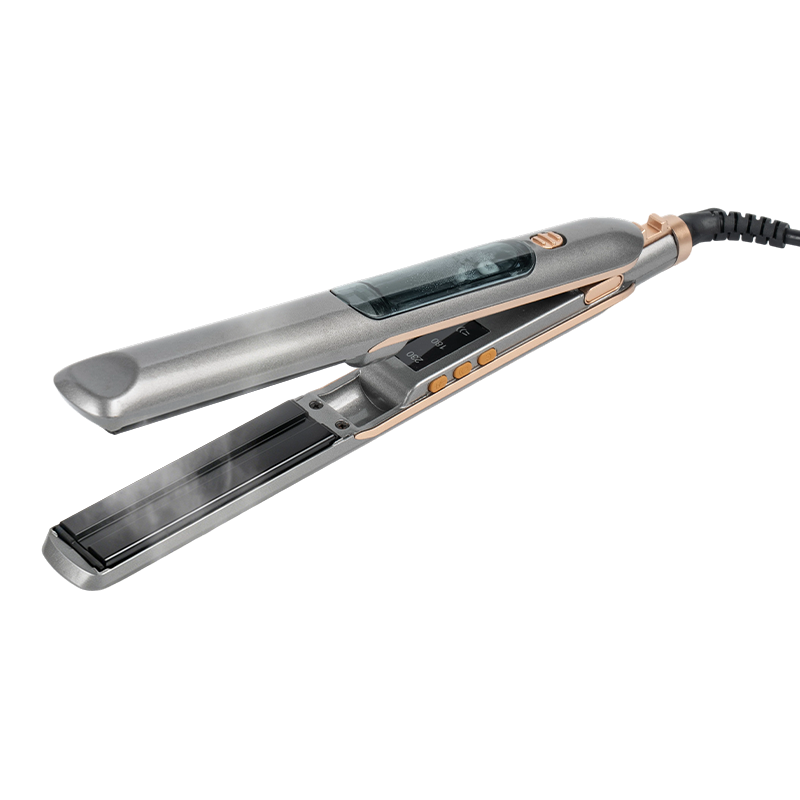
Mechanically, a steam straightener is a flat iron with a controlled water path bolted on. There are usually four subsystems worth knowing about:
- Heating elements — PTC ceramic or MCH metal-ceramic heaters inside two plates, holding the working temperature near the set point.
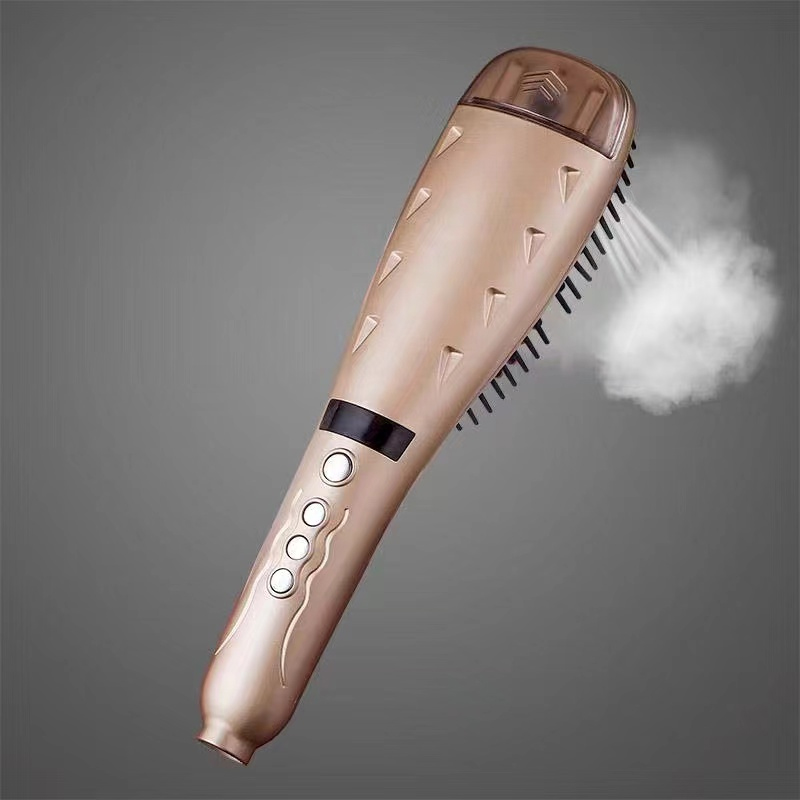
- Vapor chamber — flash-converts water into a fine mist released through small ports on the plate face or along the teeth.
- Water delivery — either gravity drip or a micro pump. Pumps meter far more precisely, but the pump is also the first part to wear out.
- Control board — NTC thermistor, microcontroller, auto shut-off, and on some models a motion sensor that cuts heat when the tool is set down.
For thick, high-porosity hair, two of these matter more than anything on the marketing page. The first is working width: a 25 mm plate gripping a 4C section means multiple overlapping passes, while a 30–40 mm plate covers more ground in one stroke. The second is where the steam exits. Ports distributed along the teeth even out the moisture; a single central hole wets the middle of the section and leaves the edges dry.
That second detail is where a lot of samples look fine at a trade show and then fail in a consumer's bathroom after two months. Paper specifications are cheap to write. Consistent vapor delivery is not.
Our own MXN302 nanoscale steam balance straightener was built around exactly that problem, routing vapor across a floating panel rather than punching it through the center of the plate.
The Specifications That Decide Whether It Works
Ignore the marketing adjectives and read the numbers. On coily hair, these six parameters separate a tool that works from one that just dries the surface.
| Specification | Why it matters on coily hair | Common working range |
|---|---|---|
| Plate temperature | Higher heat damages an already weakened cuticle | 150–190°C |
| Temperature stability | Drift forces extra passes to compensate | Within ±5°C of set point |
| Steam duration per section | Too much wets the bundle, too little will not soften it | 2–4 seconds of vapor |
| Plate width | Narrow plates cannot grip a dense 4C section | 24–40 mm |
| Floating plate travel | Follows the natural curve instead of crushing one spot | 2–5 mm of vertical float |
| Heat-up time | Long warm-up means longer total heat exposure | 20–40 seconds |
A Routine That Holds Up on 4B and 4C Hair
The tool matters less than the sequence. This is the order that survives contact with real hair.
- Blow-dry first. Steam works on stretched hair, not on wet hair, and a rough blow-dry removes most of the mechanical resistance before the plates ever touch it.
- Section into bundles no thicker than two to three centimeters. Thicker bundles force extra passes and extra heat.
- Apply heat protectant per the label, concentrating on mid-lengths and ends rather than the roots.
- Start at 160°C. Fine or color-treated hair may only need 150°C; coarse, resistant strands can go to 180°C.
- One pass, then one more if needed. Do not chase a single stubborn coil with a third and fourth stroke.
- Clamp and hold for three to five seconds before releasing. The residual heat finishes the job.
- Refresh with a light mist the next day rather than layering oil over already-styled hair.
Step six is the one most people skip. Releasing immediately leaves the bond set only partially, and by evening the section has crept back — which then gets blamed on the device instead of the technique.
Between sessions, a cool atomized mist does more than a heavy butter. Products like our MXN303 steam atomizing water ion conditioner exist for that stage, adding moisture back without asking you to run the plates again.
Where Most People Go Wrong
Almost every disappointing result traces back to one of a short list of mistakes, and none of them are about the brand of the tool.
- Treating steam as a substitute for blow-drying. It is not, and wet hair under a hot plate is the fastest route to heat damage.
- Running the same temperature on wet hair as on dry hair, which dumps the entire heat load into the water rather than the strand.
- Loading sections too thick, then blaming the tool for needing five passes.
- Parking the plates in one spot for more than two or three seconds while reading a message.
- Applying heat protectant only on the final pass, when it should be in from the start.
- Expecting a full week of hold in humid weather from a non-chemical method.
If you are checking an unfamiliar imported model, go through the basics before you plug it in: cable rating, auto shut-off behavior, and what the plates do when the thermostat fails. There is a practical walkthrough on how to tell if a hair straightener is safe that covers the checks worth doing.
What Brands Should Lock Down Before Ordering
If you are sourcing steam straighteners for a textured-hair audience, the checklist below matters more than the colorway. We have watched enough sample rounds to know where the cost savings usually hide.
- Heater lifespan — ask for a run of at least 15,000 heat-and-hold cycles with no more than ±5°C drift at the end.
- Pump endurance — request mean-time-between-failures data in writing, not as a verbal reassurance.
- Reservoir sealing — insist on a sample that has sat inverted for 72 hours without seepage.
- Scale resistance — without a mineral-control design, vapor ports clog within months in hard-water markets.
- Plate coatings — titanium, ceramic glaze and nano coatings each feel different; test every option on a 4C swatch before committing.
- Electrical approvals — UL or ETL for the United States, CE and GS for Europe, PSE for Japan. The model number on the certificate must match the nameplate on the carton.
Cosmetics come after function. Multi-color injection molding and water-transfer finishes earn shelf presence, but if the internal assembly cannot survive a thirty-minute continuous session, return rates will report the problem for you.
Our range covers straightening, curling, rotary styling and steam care, all built in-house from tooling through final assembly, so a full styling appliance lineup can be reviewed from one supplier rather than four.
Steam does something specific and limited for Black hair. It lowers the temperature required to get a smooth result, and it only delivers that benefit when the vapor is metered, the plates are wide enough to grip a real section, and the thermostat actually holds its set point. A mid-priced tool with honest steam output, used correctly, will outperform an expensive one used badly.
Get the fundamentals right first: dry the hair, stretch it, section it thin, keep the temperature under 180°C, and let each pass cool before you judge it. The rest follows.